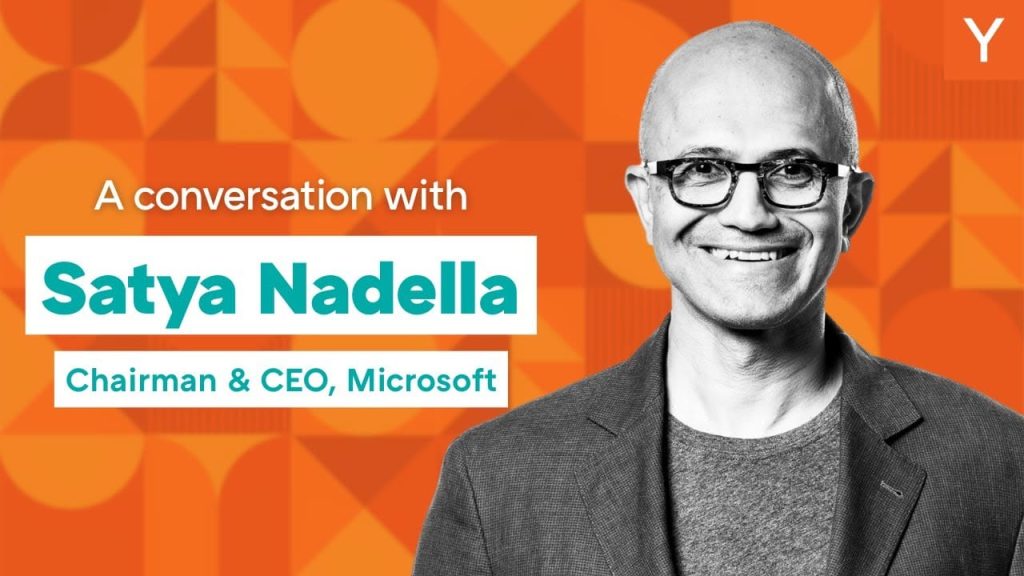
This briefing summarises key themes and insights from Satya Nadella's discussion on Microsoft's AI strategy, hyperscaling, and quantum computing breakthroughs. Nadella, Chairman and CEO of Microsoft, frames AI as a transformative platform that will drive economic and GDP growth, while emphasizing the critical need for social utility and effective change management.
1. AI as a Foundational Platform and Economic Driver
Nadella positions AI as the “fourth” platform shift, following client-server, web/internet, and mobile/cloud. He highlights the compounding effects of these platforms, stating, “if the cloud was not there, we wouldn't have been able to build the AI supercomputers which then led to the models which then led to the products.” This interconnectedness accelerates AI's diffusion rate.
The ultimate benchmark for AI, according to Nadella, is its ability to “drive ultimately economic growth and GDP growth.” He asks, “is it creating surplus in the world around us one community one country one industry one company at a time?” This focus on tangible economic and social benefit underscores Microsoft's broader strategic vision for AI.
2. The Evolution of the Application Layer and the “SQL Moment” for AI
Nadella observes a current “lumpy moment” where models have advanced rapidly, but compute and applications need to catch up. He poses the question: “is the model like SQL or is it the SAS app itself and the model?” He believes that the model can be treated like a stable platform layer, akin to SQL, enabling the creation of “pretty sophisticated products.” This “SQL moment” for AI implies a standardisation that allows for more robust application development.
He stresses that the “model scaffolding and all this tool calling… there's a real app server that you kind of need in order to be able to build sophisticated applications.” The critical element for product creation lies in the “feedback loop the data path inside the product that then is used in order to post train in order to be able to do the right tool selection.”
3. Energy Consumption, Social Permission, and Real-World Impact
A significant concern raised by Nadella is the energy consumption of AI. While acknowledging current figures are relatively low (2-3% of US energy), a doubling to 6% would be “massive.” He asserts that if AI is to consume such energy, it “better have social permission to use energy.” This permission is earned by ensuring AI's output is “socially useful” and creates “social surplus economic surplus as measured by countries and communities.”
He provides compelling examples of AI's potential to drive real-world impact, particularly in public services. He highlights how AI can streamline processes like mortgage applications, reducing wait times and bureaucracy. In healthcare, where a large portion of GDP is spent on “clerical work,” Nadella suggests that even a simple integration of an LLM with an EMR system could “save so much time and money and energy that it would sort of pay for itself.” He uses the example of a physician's time being freed from “paperwork to the patient” as a direct benefit.
4. The Biggest Rate Limiter: Change Management and Workflow Transformation
Nadella identifies “change management” as the “real rate limiter for AI deployment today.” He uses the analogy of fax-based sales forecasting being replaced by email and Excel to illustrate how “the work artifact and the work flow changed.” Similarly, AI will necessitate a fundamental shift in how people work and even the “scope of your job.” He cites LinkedIn's move towards “full stack builders” as an example of job role redefinition driven by new technologies.
He notes the prevalence of “forward deployment engineers” even in AI startups, similar to the Palantir model, specifically because of the need to “help customers partners really understand the benefits of any product you're creating but not just the technology but even how to use the technology in a workflow.” He also emphasizes the opportunity to eliminate “drudgery… in knowledge work,” freeing up human “prefrontal cortex” for synthesis rather than mundane tasks.
5. Future Frontiers in AI: Algorithmic Breakthroughs, Memory, Tools, and Entitlements
Nadella foresees continued advancements, stating, “this field is changing so rapidly.” He is particularly interested in whether “some new algorithmic breakthrough” will emerge, as the “last big breakthrough algorithmically has not yet been found.” He also anticipates “the next step up” being an “end to end training loop” beyond pre-training and post-training techniques.
He identifies three key “first class” systems that need to be built around models to create more sophisticated applications:
- Memory: For sustained interactions and continuity.
- Tools Used: The ability of AI to effectively leverage external tools.
- Entitlements: “Basically if I'm going to take action what entitlements do I have to take action.” This refers to access control and business logic, ensuring agents operate within defined permissions.
6. The Future of Software Engineering: From Typists to Architects
Nadella acknowledges the common concern about the future of software engineering. He uses a “thought experiment” of a Martian observing human work: in the 1980s, people had “typist pools,” but today, “all eight billion people are typists now.” He believes that “all of us are going to be creating software but there is going to be a job called a software engineer it's going to be different.” He suggests a shift where software engineers become “software architects,” focusing on “metacognition” of the codebase and ensuring quality.
He stresses the ongoing human role, particularly due to “legal liability” resting with “humans and institutions humans build.” This necessitates “a lot of tools for humans to be in the loop in order to figure out what these things are doing.”
7. Overhyped vs. Underhyped in AI
Nadella concedes that the industry is “not short of overhyping” AI, particularly around “the model capability.” However, he believes the “underhyped story” is the real-world impact and diffusion of AI. He cites the example of an Indian farmer using a WhatsApp chatbot to access agricultural subsidies as an “unbelievable” demonstration of how technology “built in the west coast of the United States get to a real use case that fast.” He states, “if we can somehow get the world to recognize that this is making a real difference in the lives of people everywhere we're in good shape.”
He also points to the World Bank study in Nigeria and Latin America, which found that access to tools like GitHub Copilot is “probably the best tech intervention in education” in those regions, realizing a long-held dream in tech.
8. Quantum Computing and its Synergy with AI
Microsoft has been investing in quantum computing for over 20 years, focusing on “fault tolerant quantum computer” and “stable cubits.” Nadella announces a “physics breakthrough” with the fabrication of the Majorana particle. He sees quantum computing as the best way to “understand the language of nature which is simulation,” while viewing AI as “an emulator of that simulator.” He is “very excited about what AI plus quantum and HPC in a loop can do.”
9. Personal Philosophy and Leadership Qualities
Nadella advises aspiring builders to embrace their current role with “the highest ambition for yourself on what you want to get done,” rather than waiting for future promotions. He emphasizes the importance of teamwork: “big things are achieved by having a team around you learn how to work in teams making teams great.”
He looks for three qualities in people and teams:
- Clarity: The ability to “drop into an ambiguous uncertain situation and bring clarity.”
- Energy Creation: People who “are also really able to bring multiple constituents” together and “create energy.”
- Solving Over-Constrained Problems: Individuals who can “take an over constrained problem and figure out how to unconstrain it.”
10. The Future User Interface: Agents as Computers
Nadella envisions a future where “these agents become your computers” and “do the computer use for you.” This shift requires absolute “trust,” encompassing “precision,” “privacy,” and “sovereignty” – considerations that Microsoft, like Apple, is at the forefront of protecting for all computer users and nations. He highlights the current experience with Copilot in Windows as a “new browser moment” where “both vision and speech” allow for a more natural interaction with the computer.